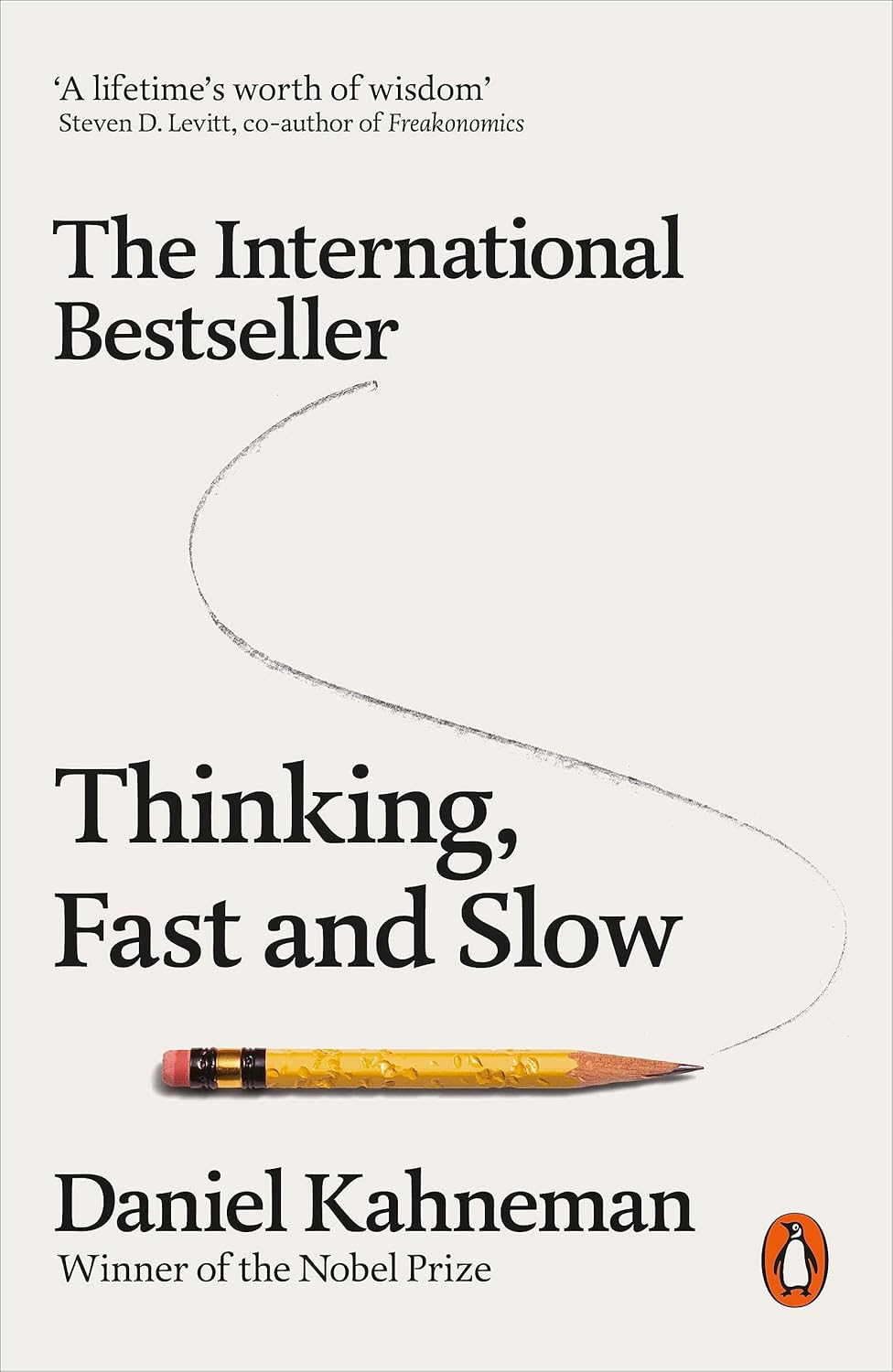
Description
In this groundbreaking masterpiece, Nobel laureate Daniel Kahneman reveals that our minds are split between two competing systems. System 1 is fast, intuitive, and emotional; it’s the part of your brain that makes snap judgments and spots patterns. System 2 is slower, more deliberative, and logical; it’s the part that does the heavy lifting of complex calculation.
Kahneman demonstrates that while we believe we are rational System 2 thinkers, we are actually being steered by the biases and shortcuts of System 1. From the Planning Fallacy to Loss Aversion, Kahneman catalogues the cognitive errors that trip up even the most brilliant experts. This isn’t just a book about psychology, it is a profound exploration of why we constantly misjudge reality and how we can train ourselves to think more clearly.
Kahneman’s work provides the psychological foundation for Brooks’s law. Why do managers continue to add manpower to late projects when the data proves it makes them later? Because of the Planning Fallacy and Overconfidence Bias.
System 1 looks at a late project and intuitively feels that more hands equals more speed. It ignores the System 2 maths of communication overhead and training lag. Kahneman shows that we are biologically wired to be optimistic about our schedules and blind to the “Unknown Unknowns” of complexity. This book explains the”why” behind the disaster: we violate Brooks’s Law because our “Fast” brain is addicted to simple solutions for complex problems.