Description
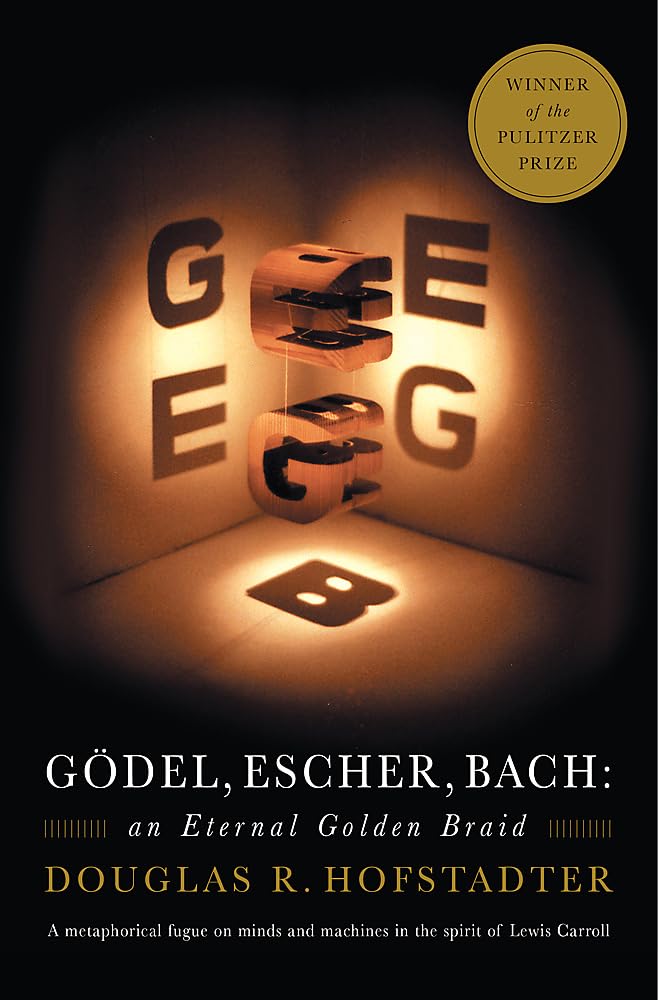
How can a self-aware “I” emerge from a collection of inanimate neurons? Douglas Hofstadter explores this mystery through the interlocking genius of mathematician Kurt Gödel, artist M.C. Escher, and composer J.S. Bach. By weaving together paradoxes, puzzles, and dialogues, Hofstadter reveals the strange loops that allow meaning to transcend the formal systems that support it.
From the fugues of Bach to the self-referential drawings of Escher and the incompleteness theorems of Gödel, this book is a playful yet profound journey into the heart of cognitive science. It suggests that consciousness is not a thing we have, but a pattern: a recursive map that eventually turns back on itself to create the miracle of intelligence.
While often cited as a joke among programmers, Gödel, Escher, Bach provides the deep philosophical reason why this law is an inescapable truth of the universe: recursion.
Because our minds (and our projects) are built on strange Loops, we are perpetually trapped in a self-referential cycle. When we estimate a task, we are using a system to measure itself. Hofstadter shows that as soon as you think you’ve accounted for the complexity, that very act of accounting creates a new layer of complexity. This book explains why The Plan is always an illusion; in a recursive world, the map can never fully capture the territory without becoming as complex as the territory itself.