Description
Numbers can’t lie, but people can lie with numbers. Brandolini’s law thrives because we assume that data is an objective truth. Calling Bullshit reminds us that data is a human product, subject to all the same biases and manipulations as a campaign speech.
Bullshit has evolved. It no longer just relies on flowery rhetoric or weasel words. Today, it speaks the language of maths, science, and statistics. Professors Bergstrom and West argue that while we are getting better at spotting old-school lies, we often feel unqualified to challenge a claim once a bar graph or a “p-value” is involved.
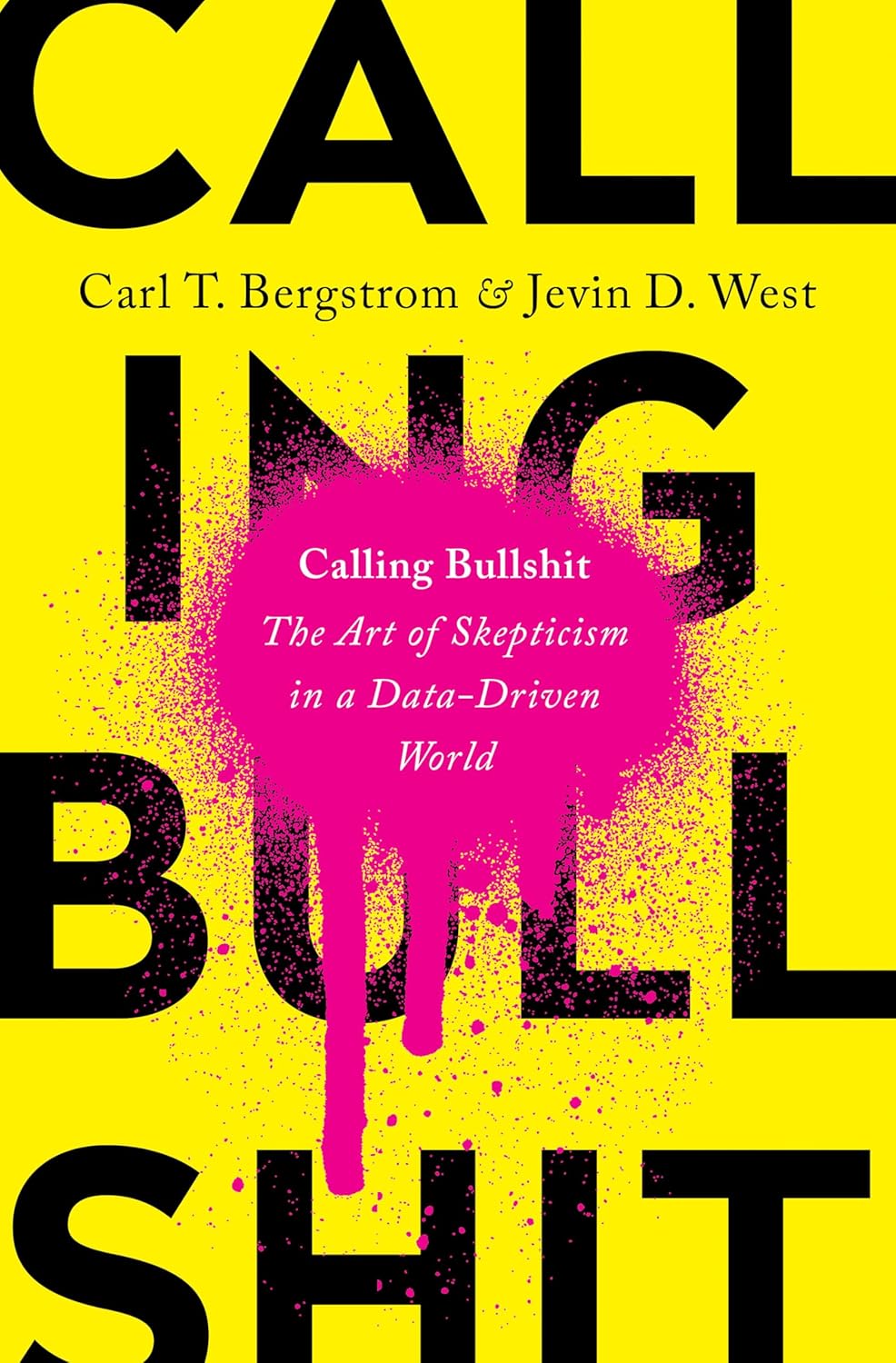
Calling Bullshit changes that. You don’t need a PhD in computational biology to see through muddled data visualization, selection bias, or the classic confusion of correlation with causation. Drawing on high-stakes examples from startup culture to hyperpartisan media, the authors provide a toolkit for cutting through the most intimidating data and reclaiming the art of skepticism. It is an exuberant, essential guide for anyone who wants to think clearly in an age of science by press release.
Brandolini’s law is the central challenge Bergstrom and West address. It takes a second to tweet a fake statistic, but it takes an hour of research to prove why it’s wrong. Because of this asymmetry, the world is currently drowning in data-driven noise.
The authors teach you how to call bullshit efficiently. By focusing on the logic of the claim rather than getting bogged down in the raw numbers, you can bypass the energy drain of Brandolini’s law. This book is your filter: it allows you to identify the 90% of data-crud instantly, so you don’t waste your life trying to debunk every individual drop of nonsense.