Description
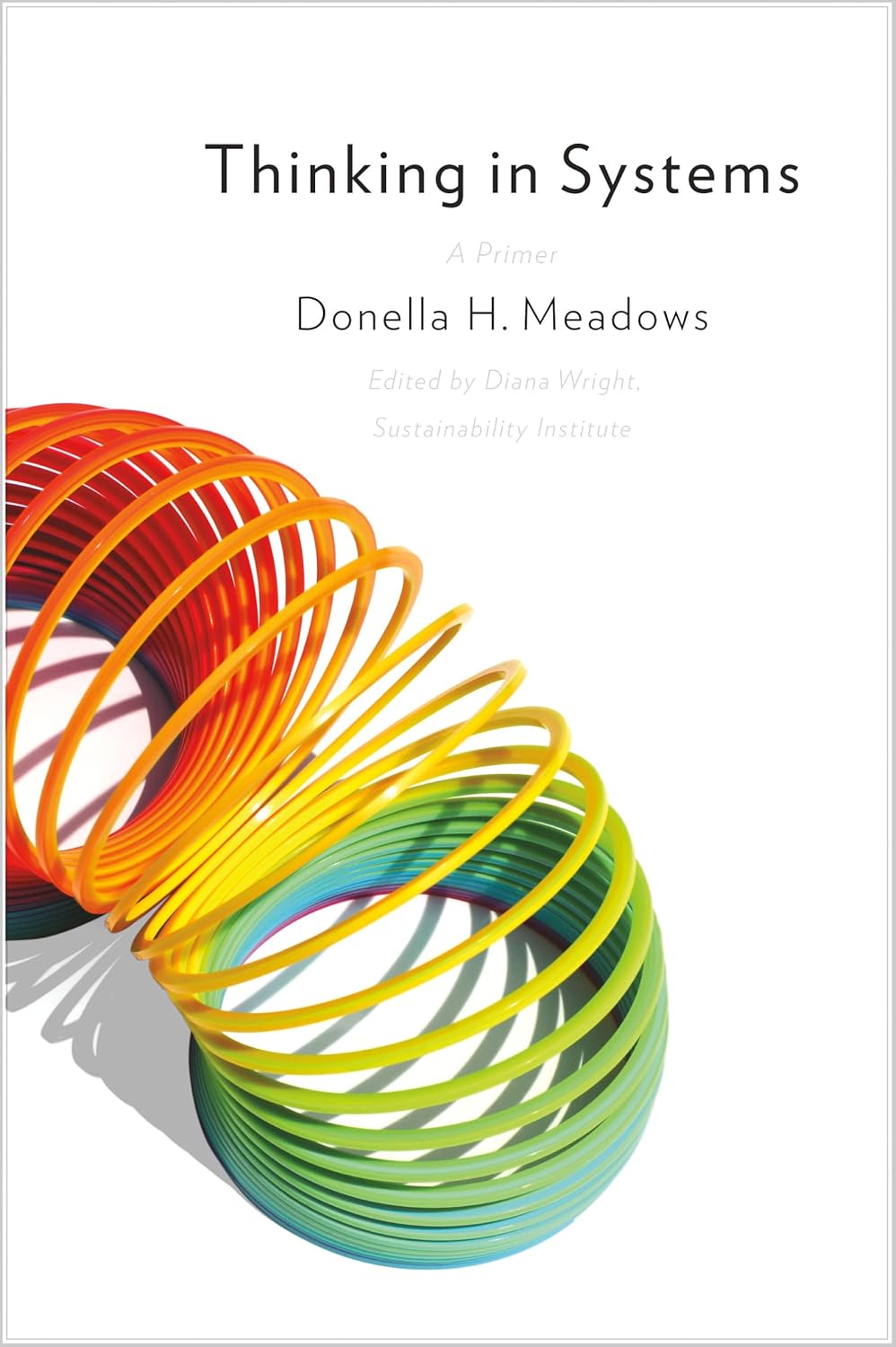
The most daunting problems of our age — from environmental decay to systemic poverty — are rarely the result of a single broken part. They are system failures. Donella Meadows, a pioneer in systems analysis, brings the discipline out of the realm of cold equations and into the tangible world. She reveals that the “obvious” solution to a problem often makes it worse because we fail to account for feedback loops, delays, and hidden incentives.
Thinking in Systems is a guide to developing the mental elasticity required for 21st-century life. It teaches readers how to identify leverage points: the places within a complex system where a small shift can lead to a fundamental transformation. More than just a methodology, Meadows’s work is a philosophical reminder to prioritise what is important over what is merely quantifiable, urging us to remain humble learners in a complicated, interdependent world.
Goodhart’s law is a classic example of what Meadows calls a “system trap.” She identifies this specific malfunction as “Rule Beating,” where the actors in a system follow the letter of a rule or metric while completely subverting its intent.
In a complex system, the goal is its most powerful leverage point. If the goal is incorrectly defined as a numerical metric (like “test scores” or “arrest quotas”), the system will reorganise itself to hit that number with ruthless efficiency, often at the expense of the actual purpose (education or public safety). This book is the ultimate diagnostic manual: it explains that Goodhart’s law isn’t just an annoyance, it is a structural failure that occurs whenever a system’s “purpose” is eclipsed by its “measurement.”